
Blog
How to Grow Crocus: Spring’s First Flowers, and the Saffron Alternative

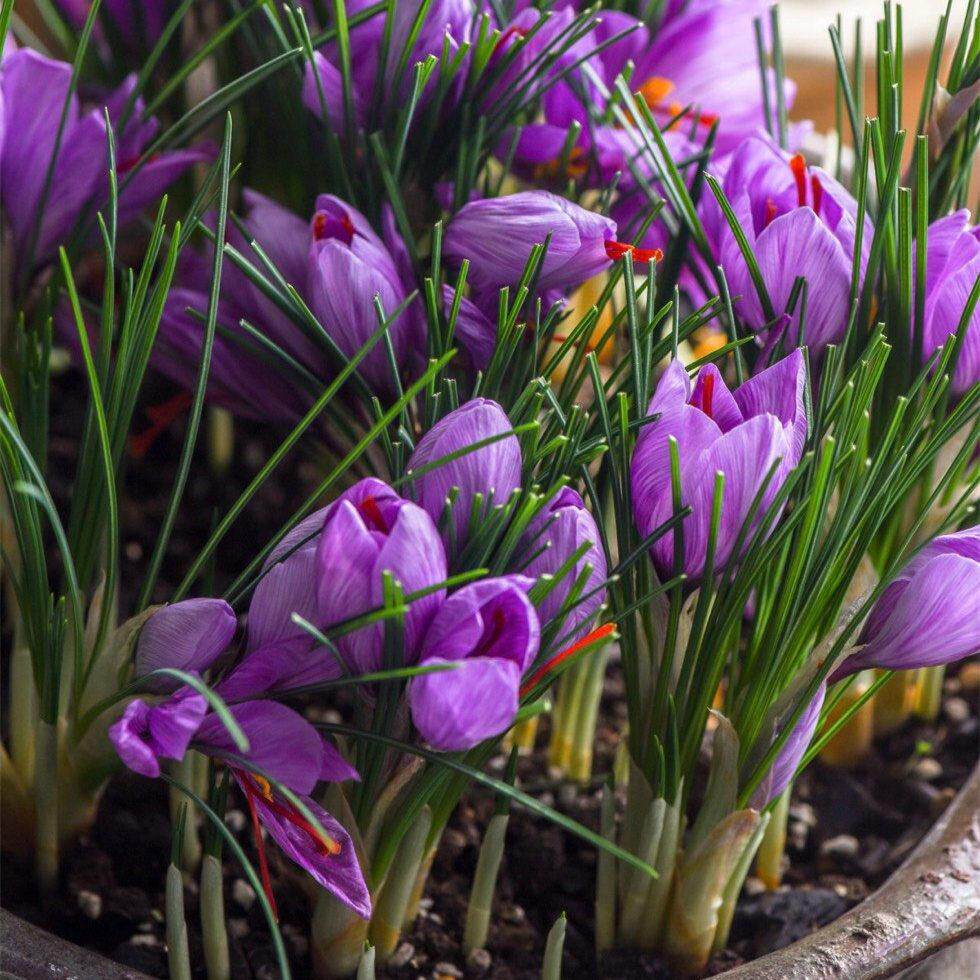
Crocus are the bulbs that break winter. They will push up and flower while there is still snow on the ground, opening their cups to any sun that appears and closing them again at dusk or when it rains.
Ready to plant? Shop Saffron Crocus Corms at Alasines → Free U.S. shipping and a 30-day arrive-alive guarantee.
They are also small, cheap and almost maintenance-free, which makes them the easiest way to add colour to a lawn, a rockery or the front of a border.
Two different plants, one name
It is worth knowing which crocus you have, because the planting season is different for each.
- Spring-flowering crocus — the familiar purple, white and striped yellow varieties (Crocus vernus, Crocus chrysanthus and their many cultivars). Plant these in autumn. They flower February to April.
- Autumn-flowering crocus — including Crocus sativus, the saffron crocus, and Crocus speciosus. Plant these in late summer. They flower September to November.
Autumn crocus are often confused with colchicum, which look similar but are a different genus entirely — and all parts of colchicum are toxic, so wash your hands after handling.
How to plant crocus
Corms are small, so planting is quick work.
- Depth: about three to four inches, which is three times the corm’s own height.
- Spacing: three to four inches apart for a dense carpet; two inches is fine if you want them to knit together.
- Orientation: pointed end up, and the flat base with the small round scar downwards.
- Soil: any free-draining soil. Crocus rot in wet, compacted ground, so add grit if yours holds water.
Plant in groups rather than single lines. Ten corms in one square foot looks far better than ten corms in a row.
Sun and position
Crocus open fully only in sun, so plant where they will catch it — ideally somewhere you can actually see them from a window, because you will not want to go out in the cold to admire them.
They work well under deciduous trees and shrubs, because they flower and finish before the leaves come out and shade them.
Naturalising in a lawn
This is where crocus earn their place. Scatter a handful of corms across the grass and plant each one where it lands — this gives the informal, random spread you want.
Use a bulb planter or lift a flap of turf with a spade, tuck the corm into the soil beneath, and press the turf back down.
Mow as normal through winter, then stop mowing in the area where they are flowering. Let the leaves die back naturally for about six weeks after the flowers finish, then resume mowing. The one thing that will kill a naturalised crocus colony is regular mowing during that six-week recharge.
After a few years the clumps will thicken and spread on their own.
Squirrels, mice and other thieves
Crocus corms are a favourite food for squirrels, mice and voles, and because the corms are small they disappear quickly. Helpful measures:
- Soak corms briefly in water before planting and plant immediately — the smell of freshly disturbed soil attracts rodents.
- Lay a sheet of chicken wire flat about two inches below the surface. Shoots pass through; paws do not.
- Plant in pots and sink the pots into the ground, or grow them in containers on a balcony or windowsill where rodents cannot reach.
Growing saffron crocus
Crocus sativus is a genuine autumn-flowering crocus, and the source of the world’s most expensive spice. Each flower produces three deep red stigmas.
Harvest them on the morning they open, when the flowers are still slightly closed, and pull the stigmas out with tweezers. Dry them somewhere warm and dark for a few days, then store in an airtight jar away from light.
Be realistic about yield: it takes roughly 150 flowers to produce one gram of dried saffron. Most growers keep saffron crocus as a beautiful autumn plant first and a spice crop a distant second — you need around 50 corms to flavour a few dishes a year.
Plant saffron corms in late summer, in full sun and very well-drained soil, four inches deep and four inches apart. They flower within weeks of planting.
After flowering
Let the narrow grassy leaves stay in place for six weeks after the flowers fade, then tidy them away if you wish. Do not tie them in knots. Divide congested clumps every three or four years, in the dormant season, and replant the largest corms.
Start with a handful
Our crocus bulbs are sold in generous counts, because a few are never quite enough. If you are planting for early colour, browse the full collection — hyacinths, tulips and daffodils all follow on neatly behind crocus, giving you flowers from February into June. Every order ships free with our 30-day arrive-alive guarantee.
Shop the plant
Saffron Crocus Corms
Free U.S. shipping · 30-day arrive-alive guarantee · Ships in 1–2 business days.